Wednesday, December 08, 2021

HONOUR THY FATHER AND THY MOTHER: EXODUS 20:12 - LEF FITYEI!! GUD NOR LEK DAT!


“Honour thy father and thy mother…”


KJ21

“Honor thy father and thy mother, that thy days may be long upon the land which the Lord thy God giveth thee.

ASV

Honor thy father and thy mother, that thy days may be long in the land which Jehovah thy God giveth thee.

AMP

“Honor (respect, obey, care for) your father and your mother, so that your days may be prolonged in the land the Lord your God gives you.

AMPC

Regard (treat with honor, due obedience, and courtesy) your father and mother, that your days may be long in the land the Lord your God gives you.

BRG

¶ Honour thy father and thy mother: that thy days may be long upon the land which the Lord thy God giveth thee.

CSB

Honor your father and your mother so that you may have a long life in the land that the Lord your God is giving you.

CEB

Honor your father and your mother so that your life will be long on the fertile land that the Lord your God is giving you.


THE LESSON FOR TODAY IS:
RESPECT, LOVE AND BE CHARITABLE TO YOUR PARENTS AND YOUR ELDERS !

"Honour thy father and thy mother" (Hebrew: כַּבֵּד אֶת אָבִיךָ וְאֶת אִמֶּךָ לְמַעַן יַאֲרִכוּן יָמֶיךָ) is one of the Ten Commandments in the Hebrew Bible. The commandment is generally regarded in Protestant and Jewish sources as the fifth in both the list in Exodus 20:1–21, and in Deuteronomy (Dvarim) 5:1–23. Catholics and Lutherans count this as the fourth.[1]

These commandments were enforced as law in many jurisdictions, and are still considered enforceable law by some.[2][3][4][5] Exodus20:1 describes the Ten Commandments as being spoken by Yahweh, inscribed on two stone tablets by the finger of God,[6] broken by Moses, and rewritten on replacement stones by the Lord.

ChristianEdit

CatholicismEdit

The import of honouring father and mother is based on the divine origin of the parental role:

The divine fatherhood is the source of human fatherhood. (Ephesians 3:14) This is the foundation of the honour owed to parents. ... It is required by God's commandment. (Exodus 20:12) Respect for parents (filial piety) derives from gratitude toward those who, by the gift of life, their love and their work, have brought their children into the world and enabled them to grow in stature, wisdom, and grace.[39]

According to the teachings of the Catholic Church, the commandment to honour father and mother reveals God's desired order of charity – first God, then parents, then others.[40] Keeping the commandment to honour father and mother brings both spiritual and temporal rewards of peace and prosperity, while failure to honor parents harms the individual as well as society.[41]The pervasive societal effect of obedience or disobedience to this command is attributed to the status of the family as the fundamental building block of society:

The family is the original cell of social life. ...Authority, stability, and a life of relationships within the family constitute the foundations for freedom, security, and fraternity within society. The family is the community in which, from childhood, one can learn moral values, begin to honour God, and make good use of freedom. Family life is an initiation into life in society.[42]

The Gospel of Luke notes that, as a child, Jesus was obedient to his earthly parents. For a child in the home, the commandment to honour parents is comprehensive, excluding immoral actions. Grown children, while not obligated to obedience in the same way, should continue to afford respect for parental wishes, advice and teaching.[43]"Filial respect is shown by true docility and obedience. 'My son, keep your father's commandment, and forsake not your mother's teaching. ... When you walk, they will lead you; when you lie down, they will watch over you...'" (Proverbs 6:20–22)[44]

The Church teaches that adult children have a duty to honour their parents by providing "material and moral support in old age and in times of illness, loneliness, or distress".[45]This honour should be based on the son or daughter's gratitude for the life, love and effort given by the parents and motivated by the desire to pay them back in some measure.[46]

The principle of the commandment is extended to the duty to honour others in direct authority, such as teachers, and employers.[47] The commandment to honour father and mother also forms a basis for charity to others when each person is seen, ultimately, as "a son or daughter of the One who wants to be called 'our Father'."[48]Thus, charitable actions are viewed as extensions of the honour owed to the heavenly Father.

Orthodox ChurchEdit

Father Seraphim Stephens sees "Honor" defined as "Love and Respect", and notes that this commandment is positioned between those that address one's obligations to God and those that relate to how one treats others. "It clearly lays the foundation of our relationship to God and to all other people."[49] Richard D. Andrews points out that, "Every time we do something good, just, pure, holy, we bring honor to our parents."[50]

ProtestantismEdit

John Calvin describes the sacred origin of the role of human father (which thus demands honour). The analogy between the honour of parents and the honour of God himself is further strengthened by this understanding that earthly fatherhood is derived from God's Fatherhood. Thus the duty to honour does not depend on whether the parent is particularly worthy. However, Calvin acknowledges that some fathers are outright wicked and emphasizes there is no excuse for sin in the name of honouring a parent, calling the notion "absurd".[51]

Since, therefore, the name of Father is a sacred one, and is transferred to men by the peculiar goodness of God, the dishonouring of parents redounds to the dishonour of God Himself, nor can any one despise his father without being guilty of an offence against God, (sacrilegium.) If any should object that there are many ungodly and wicked fathers whom their children cannot regard with honour without destroying the distinction between good and evil, the reply is easy, that the perpetual law of nature is not subverted by the sins of men; and therefore, however unworthy of honour a father may be, that he still retains, inasmuch as he is a father, his right over his children, provided it does not in anywise derogate from the judgement of God; for it is too absurd to think of absolving under any pretext the sins which are condemned by His Law; nay, it would be a base profanation to misuse the name of father for the covering of sins.[52]

— John Calvin, commentary on Exodus 20:12 and Deuteronomy 5:16

The commentary of John Wesley on the commandment to honour father and mother is consistent with the interpretation in the Catechism of the Catholic Church. He summarizes the actions that express honour as follows: 1. An inward esteem of them, outwardly expressed, 2. Obedience to their lawful commands (Ephesians 6:1–3), 3. Submission to their rebukes, instructions and corrections, 4. Acting with consideration of parental advice, direction and consent, 5. Giving comfort and providing for physical needs of aged parents.[53][54] Like the Catechism, Wesley also teaches that the commandment includes honouring others in legitimate secular authority. He also encourages people toward honour of those in spiritual leadership with the question, "Have ye all obeyed them that watch over your souls, and esteemed them highly in love for their work's sake?" This question is reminiscent of Paul's statements to the church in Galatia and to Timothy.[55]

Matthew Henry explains that the commandment to honour father and mother applies not only to biological parents but also to those who fulfill the role of mother or father. He uses the example of Estherhonouring her guardian and cousin Mordecai:

Mordecai being Esther's guardian or pro-parent, we are told ... How respectful she was to him. Though in relation she was his equal, yet, being in age and dependence his inferior, she honoured him as her father—did his commandment, v. 20. This is an example to orphans; if they fall into the hands of those who love them and take care of them, let them make suitable returns of duty and affection. The less obliged their guardians were in duty to provide for them the more obliged they are in gratitude to honour and obey their guardians.[56]

— Matthew Henry, commentary on Esther 2
Esther and Mordecai writing the second letter of Purim. Arent de Gelder, ca. 1685. Oil on canvas, RISD Museum of Art, Providence RI

The commandment itself encourages obedience "so that you may enjoy long life and that it may go well with you".[57] Henry, Wesley and Calvin affirm the applicability of this promise for all who keep the commandment, though each notes that for the New Testament Christian, the promise may be fulfilled as earthly rewards and/or heavenly rewards, as God sees fit in his wisdom and love for the individual.

In his commentary, Calvin notes the harsh consequences required in Exodus and Leviticus for specific failures to keep the commandment. Those who struck or cursed a parent were to be sentenced to death.[58]Persistently disobedient sons were to be brought before the city elders and stoned by the whole community if the parents' testimony was judged to be accurate.[59]Calvin writes that God knew capital punishment for these offences would seem harsh and be difficult to pronounce, even for those responsible for adjudicating the situation. This is why, he argues, the text specifically places responsibility for the consequences on the offender. The severity of the sentence emphasized the importance of removing such behaviour from the community and deterring others who might imitate it.[60]

Although Calvin refers mostly to fathers in his commentary on the commandment to honour father and mother, he writes near the beginning that the commandment mentions both parents on purpose.[52] As described above, Proverbs supports the value of guidance from both father and mother,[61]and Paul specified that children should provide for their own widowed mothers and grandmothers, "which is pleasing to God".[62]

Just as "honor" involves offering profound respect, the opposite of honoring someone is to trivialize him, as if of no importance.[36]

Respect is not something based solely on personal or professional qualifications, but also on the position that God has given that person. In 1 Samuel 26 David spares Saul's life, even at the risk of losing his own, submitting to the authority God had placed over him as anointed king.[36]

Tuesday, December 07, 2021

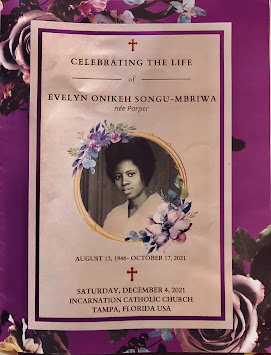
MRS EVELYN ONIKEH MBRIWA (NEE PARPER): GONE BUT NEVER WILL BE FORGOTTEN

THE LORD GAVE; THE LORD HATH TAKEN AWAY. BLESSED BE THE NAME OF THE LORD

https://youtu.be/5qMAKdTe8Uk

EUGOLY FOR MRS EVELYN ONIKEH MBRIWA (NEE PARPER)

Good afternoon, friends, family, and well-wishers; Good afternoon, Church.

You would no doubt appreciate how difficult the task of proffering this EULOGY to my dearest immediate younger sister Evelyn Onikeh is. As Jesus himself stated, in John 16:16, “ a little while , and ye shall see me, and again, a little while and ye shall not see me, because I go to the Father”.This prophesy is today manifested in the transformation of the life of our dear beloved when, on the 17th day of October 2021, Evelyn breathed her final breath; and in a little while, we shall  not see her again – even in her mortal  remains. This shining candlelight - our dear, mother, grandmother, sister and friend has been extinguished by the cruel wind of immortality.

Evelyn Onikeh Parper (Mrs Songu Mbriwa) was born on 13th August 1946 in the Bo government hospital to our parents – Mr Ansuman Beresford Parper a Prince Wealean and a career Accountant/Civil servant and Mrs Regina Omojowo Beatrice Remilekun Parper (nee Williams) an AWOGAN - a career teacher and an excellent  and dutiful mother.  Evelyn is the second of the nine children surviving child of our parents – three boys and six girls. Evelyn’s schooling from aged four (4) was turbulent as her infant and elementary education was faced with a few short years of moving from Buxton Girls infant school Freetown, to Methodist School Bo, then to Ebenezar Amalgamated School and to the Central (Post Primary ) school back in Freetown, due to the rigors of the Civil Service policy of transfers of its officials around the country. Our respite was always to revert to our grandmother Julia Agnes Williams (Nee Oldfield) in Bo and later staying with various relatives in different locations in the East and West of Freetown even through our secondary education After passing her Common Entrance Examination, Evelyn was admitted and educated at the Methodist Girls High School Freetown (1961-1965/6. After graduation, she gained the lucrative employment as a Customs Clerk at the then Customs and Exercise Department Cline Town in Freetown.

In her quest to fulfil her medical desire, Evelyn in 1968 gained a scholarship to study medicine in Kiev in the Ukraine, under the control of the then Soviet Union (USSR- RUSSIA). I fully recall the day of departure and standing with a combination of feelings of joy, happiness, and parting sadness: you all can imagine my feelings today for her departing. This today, is not like the parting of two lovers as depicted in “A Dream Within a Dream” in the (1849) poem by Edgar Allan Poe – “Take this kiss upon thou brow! And, in parting from you now, Thus, much let me avow! – You are not wrong, who deem -That my days have been a dream….”! Edgar Poe was emasculating the cyclical nature of life and death, and feelings of loss, grief, and reconciliation. Such reconciliation only comes after immortality as we Christians continue to believe in the resurrection.

In the Ukraine whilst pursuing her medical degree, Evelyn engaged with other friends some from her very own country but in this jungle of students mingling with each other in the cold and strange land, she met someone who was to become her sole mate and later her husband - Dr Tamba Songu Mbriwa!  They were soon married in 1972 and as the years flowed, moved back to Sierra Leone and thereafter to the United Kingdom (Middlesbrough). They were blessed with six (6) children: Sahr, Tamba – born in the USSR,  Sohkor (in Freetown), and after relocating  to the UK, Omo Jowo, Aiah (‘A’Boy) and Evelyn Jr (Eve).  The setting was such that with the need to care and nurture their children, Dr Tamba traversed and an NHS Medical doctor for over twenty years whilst Evelyn was content in playing her motherly role and a Housewife, bringing up their children as best she could.

In 1991 Evelyn decided to relocate to Boston Massachusetts USA, where she engaged herself once again in the medical field as a Healthcare Professional employee in several Boston Hospitals diligently performing her duties. However, the family including our late mother Regina, once again moved, this time to warm weather of Tampa in Florida and continued her service to the Medical Healthcare profession she enjoyed until she retired a couple of years ago as if she pre-empted the Covid-19 Pandemic. Being a dedicated and loving family member, Evelyn spent the last years of her life visiting and enjoying companionship of her children and grandchildren, and other member of her family crisscrossing as best she could from USA to UK and within the USA. 

I will and I am beginning to miss my sister who from time to time will entice me on the telephone for hours at times, reminiscing past events and issues since our childhood growing up together. Two incidents I will recall here: At Independence in 1961, we sneaked away on a Sunday evening to the FUN FAIR instead of going to Evening Church service. (Our aunty Kosso would not trust the environment for such crowded endeavours). In the hassle and bustle of this event, Evelyn was lost in the large crowd and getting back home to the East (Mountain Cut) was far and I was frighten of the BIG trouble I will face at home. She got home before me that night – I arrived just past Midnight. Aunty locked the door and said “ Go where you come from” in our local krio parlance (“Go ousai yu komot”). I started crying and screaming “Den di kam Katch me Ooh, Den di Kam Katch me”, until our Aunty Kosso’s husband William Davies, got very annoyed and dashed to door, opened it and let me in; of course with a SIX CUT  (six lashes of the cane on my buttucks) the next day.

The second incident was when we stowed away in an Express Train to Bo We did not buy tickets as the queue at the Ticket Window was very long as the train was soon to leave. The Guards grabbed us and put us off the train in Songo. We joined the Slow train and hid in the Third Class couch where there were many more people. But the Guards had already been informed that there are two children in the train going to Bo without tickets. By the time the train reached Rotifunk station, the guards caught us and took us to the Guards coach, only to meet a Senior Guard who was our neighbour in Bo - Bra Alimamy Kanu, (BIG RELIEF!). He took care of us, lunch, and all,(after taking the £1:14s: 3p ticket money from both of us  and issued Receipt Book Tickets), and took us home on arrival in Bo as the train was late by over two hours that evening. Evelyn always reminded me of these silly things we used to do or encountered, like the man we labelled ‘The Sugar Cane Monkey’- we caught eating our sugar cane, –  piles and piles of them until we set a trap, ambushed, and caught him at 3 O’Clock in the morning. Or in the case of a chance taking thief (tiffman), who rushed through the open front door and stole a knob from the radio gram whilst we were having a communal lunch. We chased him and tormented him until we got the “THING” back. Foolishly, we reported this happily to grandpa who then said, “Who left the Front Door unlocked”?  We all got SIX CUT (six lashes) and banned from the Next Sunday’s family visit. Discipline was paramount in our enclave. These stories, Evelyn will always bring to my memory and even the serious stuff like the 1967 MARSHALL LAW episode after the controversial General elections. She was very protective of me and at times (let me even say) jealous, because if any of her friends come too close or too pushy around me, then there is a great risk of breaking that friendship. These memories I am sure will last until we meet again.

Evelyn is survived by her Six children, and eight grandchildren. (Ellie; Kai, Emmanuel, Joshua, David, Amarius; Sia and Rebecca.); Eight siblings (Myself, Israel Parper,  Mrs Emilia Gabbidon; Mrs Adeline Cleveland; Mrs Juliana Atere; Mrs Regina Oppon; Mr Patrick Rotimi Leo David, Fr. Winston Ekuyami Vincent Davies and Ms Veronica Davies (Baby D). Aunts including Mrs Josephine Siddiqui and Hannah Jones, Uncle Mr Prince J Williams, Many cousins, wider family including the Oldfiels, Williams, Daramy, Doherty, Thompson-Davies,  Johnson, Belford; Salle, McCormack, Macfoy, etc. In-Laws including the Mbriwa Family and many others, friends in UK, USA, and Sierra Leone; past Schoolmates of the Methodist Girls high School.


THE LORD GAVE; THE LORD HAS TAKED AWAY. BLESSED BE THE NAME OF THE LORD.

MAY THE SOUL OF OUR DEAR SISTER, MOTHER, GRANDMOTHER COUSIN ETC. 

REST IN PERFECT PEACE! 


YOUR BELOVED BROTHER,

 ISRAEL OJEKEH PARPER, Snr.


Click this Link for Service at the home in London  of Evelyn’s Yonger sister Julian Baby Love https://drive.google.com/file/d/1Ngq9Gw0B2LPKF93uIcKQZajkUf4F_8jn/view?usp=drivesdk


Tuesday, August 03, 2021

LET THERE BE JUSTICE THOUGH THE HEAVENS FALL

LET THERE BE JUSTICE THOUGH THE HEAVENS FALL!

Today marks 18 years since President Joseph Saudu Momoh left this sinful world for the true world. The family still mourns the pain of losing such a gentle soul. We will not forget the inhumanity that was dealt him by the Kabba government after the sufferings him and his dear wife Hannah suffered after his overthrow by the NPRC little boys brigade Coup d’etet. Kabba deprived Momoh of his constitutional provision to his Presidential pension and gratuitous benefits. Through a so-called Cabinet Paper, he SLASHED more than 60 % of ALL that President Momoh was entitled to, and by extension, what his family were expected to have bequeathed to them after his passing. I need not go into the consequences of such deprivations, pain and suffering they encounter after his demise. But President Tejan Kabba, made sure he left the constitutional provisions in tact so the HE COULD EVENTUALLY ENJOY ALL THE BENEFITS INSHRINED IN THE 1991 Constitution! AND SO HE DID! Deprived President Momoh but secured his own position and benefits! YES! Mortal man!

As we all remember President Joseph Saudi Momoh TODAY 3rd August 2021, (he departed 3rd August 2003: I happened to be in the USA 🇺🇸 then, but was privileged to attend the Memorial cum funeral service in Virginia conducted by the also now Late Rev Rowland Timity (RIP). In attendance was also now Late Hon Dr John Kerefa-Smart -RIP) let us RECALL his words in his FIRST ever interview by Robin White of the BBC whilst President Momoh was exiled in Guinea, following his overthrow by the NPRC pikin sojas - Valentine Strasser, SAJ Musa, Tom Nuyma, Idrissa Kamara, Komba Mondeh, Maada BIO, Keli Conteh,  Joy Turay, etc. etc.

This discussion about the unfair treatment meted out to President Joseph Saudi Momoh by President Ahmed Tejan Kabba popped up at the apex of the last General Elections 2018.  By a strange coincidence, Professor Peter Dumbuya (who was by then in the USA - but now in Sierra Leone  FBC) was examining the question of a  ‘A WELFARE STATE FOR PRESIDENTS AND VICE PRESIDENTS’,  on 24th April 2018 in his Facebook Post. (Reproduced Below). In my rejoinder, (also re-produced below) I questioned or rather queried the unfair and inhuman treatment of President J S Momoh, a synopsis of my feelings is re-echoed above.

Included in this post, I have endeavoured to reproduce the very first interview of the Late President Joseph Saudu Momoh by Robin White of the BBC after he was overturned by the NPRC on 29th April 1992 when those ‘Borbor Sojas’, should have been concentrating on fighting the War/Invasion by Charles Taylor’s NPFL Rebels of Liberia and our own FODAY SANKOH RUF Rebels. I have included a Photo below of my visit to State House in May 1991 with the Late Arika Awuta Coker , Editor of the Daily Mail and Saramadi Kabba (Journalist) both part of a Concerned Citizen’s Group we marshalled for that tragic 11 years War as a pressure group.


FLASHBACK APRIL 2018

Read below : A WELFARE STATE FOR PRESIDENTS AND VICE PRESIDENTS BY PETER DUMBUYA!


My Rejoinder: 24 April 2018


Dear Prof Peter Dumbuya: You do not stop to amaze me. This is so apt and timely particularly for the small matter of the current Former President Ernest Bai Koroma, establishing his new " Office of the former President" which has  generated some interesting social media comments and the position of the former  Vice President Victor Bokari Foh and his dramatic retirement from "active politics". 

This now calls attention to the former SLPP  Vice President Berewa's position and one wonders whether what proportion of these provisions he is (if at all) is enjoying. 


It appears to me that the tinkering of the 1991 constitution by the NPRC under their DECREE NO 9 of March 1996 had but little diminishing effect. I recall that several of these DRACONIAN Decrees were reversed by Parliament when President Tejan Kabba took the reins of power in 1996. One wonders  what was his (Kabba) position and benefits upon his own retirement until his passing away? 


Furthermore, since as you pointed out his government was "astounded by the level of the burden..." upon the State of these retirement benefits, BUT THE CONSTITUTION (and appropriate sections) was neither AMENDED nor REPEALED! YET, as you observed, in 1997, 3rd of March,  "President Ahmed Tejan Kabba issued a public statement stating that "the Government was astounded by the level of the burden the State is required BY LAW to carry in maintaining a retired President". 


BUT TO WHAT LEGAL EFFECT WAS THAT PUBLIC STATEMENT FOR HIM AND HIS GOVERNMENT TO DENY THE LATE PRESIDENTJOSEPH SAIDU MOMOH HIS FULL ENTITLEMENTS UNDER THE LAW? Rather, when President J S MOMOH asked for his retirement benefits he was, as you put it,   "OFFERED ...” a monthly pension of Le900,000 (including expenses) far short of the CONSTITUTIONAL $12,000 a year; Le25million a month as provided, and many other depreviations to the late President.  

Yet, the fundamental law was neither repealed nor amended which I  effectively submit,  IS STILL THE LAW TODAY as even the CRC has failed to rectify in their review which is still NOT THE LAW!


 Therefore, it would appear to me, that President Tejan Kabba acted on impulse having just assumed office under a year, and being "astounded" indicated he was not (even being a Lawyer), wholly familia with the Provisions of the 1991 Constitution which by that time had been fully restored (following its SUSPENSION under the Military Rule of the NPRC by led by  Captain Valentine Stresses, and Julius Maada Bio who handed over to Kabba 29 March 1996). But  "ignorantia juris non excusat" (ignorance of the law is no excese).  


This is another example of the inexactitudes, errors, omissions and ‘oversights’ by our clever constitutional drafters,we have noted in other discussions that have led to and still continue to lead to confusions, Supreme Court cases and as I write, assembling and summoning of Parliament for the first time after the just concluded fractious Elections erupting a tassel between Mr Speaker vs The Clerk of Parliament. God Help Us. 


You further states that the Tejan Kabba Government "promised but did not amend or repeal..." the law which puts the FULL PROVISIONS BACK WHERE IT BELONGS (Ex quo loco referee). Therefore I will submit most profoundly, that the treatment levied upon the Late President Joseph SAIDU MOMOH and his family was unjust and and UNCONTITUTIONAL as the public statement by Late President Kabba appeared to have NO FOECE OF LAW and he had acted Ultra Vires the Constitution. 


He may have not taken or made any effort in amending or repealing the 1991 provisions because of his own interest on second thought knowing fully well,  he will one day retire. Therefore,  I feel strongly that the FAMILY OF THE late President J S MOMOH is not only entitled to an apology from the State and particularly the SLPP Leadership, but are entitled to aĺl that was denied and due to the former President and his dependants who suffered tremendous hardship by virtue of this deliberate and unconstitutional deprivation contrary to the Law of the State of Sierra Leone as Provided. THIS WAS A CALLOUS ACT AND BREACH OF HUMAN RIGHTS FOR WHICH THE FAMILY MUST NOW PURSUE IN THE COURTS  AND SEEK REDRESS! As it is said, "FIAT JUSTITIA RUAT CAELUM" (Let there be justice though the heavens fall)!

Israel Ojekeh Parper Snr

————————————————————

FLASHBACK:

Prof Peter Dumbuya

24 April 2018


A Welfare State for the President and Vice President?


Much has been said and written about politicians’ penchant to form corrupt patron-client networks and manipulate identities (ethnic, regional, and religious) to win elections or stay in office beyond their constitutionally mandated terms. Today, for example, Armenians forced Prime Minister Serzh Sargsyan out of office; he had served ten years as president before his recent reincarnation. What we don’t hear or read about often are the ways in which constitutions and laws, the very pillars of democracy in a well-ordered society, have carved out a welfare system for presidents and vice presidents. For instance, when the president and vice president of Sierra Leone retired from office at the end of their terms on April 4, 2018, they took with them a retinue of personal aides, benefits, and services, courtesy of the state, aka the People. 


It starts with Section 48(5) of the Constitution of Sierra Leone 1991 which states that “The President shall be entitled to such pension and retiring benefits as shall be prescribed by Parliament.” Parliament, representing the People, passed the implementing legislation known as “The Pensions and Retiring Benefits of Presidents and Vice-Presidents Act [No. 2], 1986.” For either office holder to receive full, life-time benefits, they should have served for at least twelve (12) months in office, otherwise the cabinet sets the value of pension, gratuity, or other benefits they, their surviving spouses, dependent children, or dependent relatives are entitled to receive for a period of not more than twelve and a half years. The Act is divided into four parts, with Parts II and III covering the substance of the benefits and services.


Part II: Pension and Gratuity 


Each retired president and vice president is entitled to “a monthly pension computed on the basis of an amount equal to the annual basic salary of a President on the day he retired from that office.” Each is also entitled to a gratuity of 30 percent of his basic salary “on the day on which the person in respect of whose retirement the gratuity is to be paid retired from the relevant office.” However, in the event the president or vice president dies in office, the pension and gratuity are to be determined by the cabinet (but not in excess of what either office holder would have received upon retirement) and payable to a widow (“widow” includes “widower”), child, relative, or dependent. Various reports I’ve read state the president’s basic salary (sans benefits and allowances) as: $12,000 a year; Le25 million a month).  


The pension and gratuity are free of estate duties (taxes) and are payable up to twelve and a half years after such death. And if either office holder dies within twelve and a half years after leaving office, the pension is payable to “his widow or if he had dependent children or dependent relatives or both, his widow and dependent children or dependent relatives or both, as the case may be,” for the remainder of the twelve and a half-year period. Pension payments terminate upon the re-marriage of the surviving spouse. Other than a debt due to the government, pensions and gratuities cannot be assigned, transferred, attached, sequestered, or levied upon by debtors.


Part III: Miscellaneous Retiring Benefits  


Each retired president and vice president is entitled to a lump sum payment (based on the last drawn salary prior to retirement) for all leave earned and not used up while in office. A retired president gets office accommodation, with a rental value of not more than Le10, 000 per year, with an office staff comprising an official of the rank of Senior Assistant Secretary, one confidential secretary, one private secretary, and two office messengers. Further, a retired president is entitled to residential accommodation at an annual value of not more than Le15,000, and a household staff consisting of two cooks, two stewards, two cleaners, two gardeners, two laundrymen, and one domestic supervisor. A retired president can opt for cash payments in lieu office and residential accommodation, staff, and services. A retired vice president, on the other hand, gets one cook, one steward, and two servants. Office and residential Staff salaries are to be approved by the cabinet. 


In addition the costs for electricity and water for office and residential accommodation are also borne by the state. A retired president continues to enjoy exemptions from all duties and taxes, while a retired vice president is exempted from all taxes and duties on personal effects imported into Sierra Leone with the president’s prior approval.

Either former office holder is entitled to travel outside Sierra Leone once a year, based on the cost of a first class return air ticket to the United Kingdom. But whereas the former president is accompanied by one secretary and one security personnel (economy class tickets), the retired vice president travels with only one security personnel. 


At home, a retired president continues to travel in style. His state-supplied fleet of vehicles include one VIP car, one escort car, one family car, and one utility car, plus four drivers, one for each vehicle. A retired vice president gets one VIP car and one utility car, in addition to two drivers. Both of them are also entitled to reasonably adequate security for themselves, their families, and residences. To these ends, a retired president is assigned three Assistant Superintendents of Police, thirty (30) personal guards, and four Watchmen, while six personal guards provide security for a former vice president. 


The cabinet, presumably under the president’s direction, is tasked with approving the costs associated with the procurement of vehicles, payment of salaries of drivers and security personnel, and maintaining the fleet of vehicles. Pension, gratuity, and other benefits are charged to the Consolidated Fund, while the Minister of Finance crafts regulations to give effect to the provisions of this Act. A source who is familiar with this Act told me that Parliament has made cost-of-living adjustments to the benefits under this Act.


It should be noted that National Provisional Ruling Council (NPRC) Decree No. 9 of March 1996 tinkered with the Act under discussion. Among other things, the Decree deleted the twelve-month qualification for full pension, gratuity, and other benefits; upheld the requirement for office accommodation but reduced the staff to five persons; provided for a retired president to travel outside the country but with one staff person; reduced the number of cars to two with two drivers for a retired president; and assigned one utility car and driver to a retired vice president.


Discussion and Conclusion


When, in 1996, former President Joseph S. Momoh asked the government for payment of his retirement benefits upon his return home from Guinea, the government of President Ahmad Tejan Kabbah issued a public statement on March 3, 1997, stating that “the Government was astounded by the level of the burden the State is required by law to carry in maintaining a retired President. Obviously, in our present economic situation, this nation is not in a position, and there is no justification, for incurring this type of expenditure on a former President.” In the end, considering “the need to be prudent and sensitive in the expenditure of Government funds,” Kabbah’s government offered the following benefits to the former president: a monthly pension of Le900,000 (to include payment for utilities, entertainment, and residential upkeep); a house; two security personnel; and a car. Even though it was “astounded” by the level of commitment, the government promised but did not amend or repeal the law to ease the financial burden on the people.


Read together, Section 48(3) which states that “The President shall be exempted from personal taxation,” Section 48 (5) which states that “The President shall be entitled to such pension and retiring benefits as shall be prescribed by Parliament,” and the “The Pensions and Retiring Benefits of Presidents and Vice-Presidents Act [No. 2], 1986,” have carved out a welfare system for retired presidents and vice presidents while most people live on less than a dollar a day. 

Further, in a system of government with separated powers and checks and balances (these provisions are more honored in the breach than in the observance), one wonders why the framers of the 1991 Constitution exempted the president from personal taxation, but not the Speaker of Parliament and the Chief Justice, heads of the legislature and judiciary respectively. 


A partial answer to this conundrum may lie in how the Constitutional Review Committee (CRC), in its 2016 report, characterized the pension and benefit scheme: “The CRC recommends that the President’s salary, emoluments and allowances drawn from the Consolidated Fund as privileges of the office of President should not be subject to taxation. The President, nonetheless is not to be exempt from personal taxation on income derived from other sources, including any enterprise, business venture in mining, agriculture, among others taxable and applicable to all other citizens. The CRC therefore recommends that section 48(3) should be amended to read as follows: “(3) The President shall not be exempted from personal taxation.””


The CRC failed the People in two key areas. First, it was not aware of or did not appreciate the fact that pursuant to Section 46(3) “The President shall not, while he continues in office as President, hold any other office of profit or emolument in the service of Sierra Leone or occupy any other position carrying the right to remuneration for rendering services.” In other words, under the “emolument” provision, a serving president cannot receive any other income apart from his salary as president. Second, the president and vice president are public servants, elected by the People and limited to two, five-year terms in office. They are accountable to the People, and can be impeached and removed from office by Parliament. These constitutional provisions should be enough to demystify the presidency. And so, serving as president or vice president is a privilege and not a right of primogeniture or some other monarchical form of succession. Paying taxes, therefore, is an obligation; exemptions from this obligation which every other adult citizen is called upon to fulfill under pain of punishment are not “privileges of the office.” Thus, the CRC did itself no favors by maintaining the status quo ante. Instead of being more positive, creative, and transformative, it kicked the can down the road when given the opportunity to craft a more perfect document.


Finally, “The Pensions and Retiring Benefits of Presidents and Vice-Presidents Act [No. 2], 1986,” had its origins in Section 27 of the 1978 One-Party Constitution which the current Constitution abolished in 1991. Nevertheless, no substantive attempt has been made to overhaul it on constitutional grounds and on the fact that it places a heavy burden on taxpayers. It is unfair for the government to tax the People in order to fund the retirement benefits of a former president who paid no personal taxes while in office, and a former vice president who, in retirement, pays no taxes or duties on personal property imported into the country from abroad. The law must be amended or repealed in the interests of fairness, the rule of law, and due regard for the People who bear the heavy burden of taxation.

—————————————————
Prof Peter Dumbuya’s followed up comments to my 
re-joinder, posted above

Peter Dumbuya  : Followed  up
“Thank you so much, Israel Ojekeh Parper Snr, for your kind words. The issues you've raised deserve to be addressed by the authorities in Freetown. To begin with, time is of the essence in this discussion. As the new Parliament and President begin their tenure in office, they have a lot to contend with, including past policies and current fiscal and financial challenges. I came across the discussion about the "office of former president" EBK, and said to myself, now is the time to complete and post this essay for public discussion. I'm sure former VP Berewa, the widow of the late President Kabbah (if he died within the limitation period), and now former President Koroma and his VP Foh have or are receiving their retirement pensions, gratuities, and benefits. As regards the NPRC, its leaders tried to help themselves by removing the 12 month requirement for benefits and by tinkering with other provisions of the Act of 1986 which Parliament passed a year after the retirement of President Stevens. You would have expected the NPRC to do away with this Act since they overthrew Stevens' hand-picked successor Momoh, but chose not to do so. They acted in their own self-interest, and not in the public interest. The same is going on in Parliament as I write. You would expect the legislative body of the state to know the Constitution and laws that govern the election of Speaker and Deputy Speaker before anything else can be done, but members choose to play the game of politics with the livelihoods of the People. As the documents I have reveal, there was an offer and acceptance of benefits by the late President Momoh from Kabbah's government which was still at war with the RUF and was facing dire economic straits. So, Kabbah made a deal with Momoh after expressing outrage at the costs associated with the benefits.”

————————————————-


Saturday, July 31, 2021

WHERE HAVE ALL THE SIERRA LEONE HISTORIANS GONE? IS THERE HOPE FOR THE FUTURE?


IB Abdullah - discusses/examines
 A Nation Without Historians: Could this be the Future of the Sierra Leonean Past(s)?


Sierra Leone’s first-generation professional historians are almost extinct; with the passing of Arthur Abraham and Cecil Fyle within a year, we are now down to a single survivor. The pioneering Durham breed which commenced the herculean task of reconstructing the Sierra Leonean past are themselves now history: dead, retired, and hors de combat in a field that has expanded beyond their collective imaginations. And this is happening at a time when there are very few practicing historians in Sierra Leone—the second generation—with sadly no inkling of a third generation in sight.


The first generation professional historians—Arthur Porter?, Akintola Wyse, Gus Deveneux, Arthur Abraham, Mac Sam Dixion-Fyle, Cyril Foray, James Lenga Koroma, Eddie Turay, Alpha Bah, Gilbert Cleo-Hanciles—with one exception have all joined the ancestors. Those with terminal degrees, not including Arthur Porter, Cyril Foray, did graduate work and completed their primary research within four/five years of each other, that is to say, between 1972 and1977. Graduating in the middle of the second decade of independence was rather late—they could all have studied at the University of Ibadan the birth place of African historiography; for Ibadan, and the four second generation universities in Nigeria, had all produced PhD’s in history by the mid-70s. But Fourah Bay College, and later the University of Sierra Leone, remained an under-graduate liberal arts school, which meant that there were no graduate programs/ students, just the rare but occasional masters student—three in the last century: Gilbert Cleo-Hanciles, Alpha Lavalie, and Festus Cole. 


Within a decade after their graduation, this pioneering cohort started trooping off to greener pastures even before they could fulfill their historic mission—Abraham was the first to depart to Liberia; followed by Wyse who moved down the coast to Nigeria; then Dixion Fyle. All this happened within five years—1977-1981. The Journal of the Historical Society of Sierra Leone— a script taken from Nigerian and Ghanaian historians—started life in 1977 but unfortunately choked to death when Abraham the founding editor left for Liberia. As Head of African Studies, Magbailey Fyle would continue editing the Africana Research Bulletin, the flagship publication of African Studies, not history. With his departure to the US, Abraham, who had returned, would take over African Studies until he himself immigrated to the US in the late 90s, leaving Wyse, the last man standing, solely in charge of the abandoned manor.


So a department that started life with Arthur Porter as chair, succeeded by a British expatriate, Peter Kup, and an American in the 60s, John Paterson, who would remake the department by offering the first course in African history, ran a top-heavy undergraduate program straight into the twenty first century when it was mistakenly merged with the externally mid-wifed African Studies program—a US sponsored outfit dubbed ‘Africanist enterprise’ by leftist critics. The 1960s saw, not only, the establishment of the Institute of African Studies but also the beginning of a full fledged history department with courses in African history and an honours program. 


But History, the abused queen of the humanities/social sciences, has not been as popular as it used to be—few students now want to offer history or major in a discipline that seemingly has no utilitarian value outside telling boring stories about a past no one cares about/want to remember. So students now troop to law en mass at FBC. At Njala and Unimak history is visibly absent in the menu; it is as if the end of history has been proclaimed with the fundamentalist embrace of a dis-anchored STEM that promises a rosy future with no sense of the past. Years ago attempts to recruit graduate students after a colleague at an American university offered to guarantee a four-year graduate funding fell apart because there were none to recruit. Law and the social sciences, erroneously seen as lucrative professional pathways, are sucking in students from history at a time when historians are needed to engage in the task of producing historical knowledge for/about the nation-state and the continent of Africa. 


The fall in student enrollment for history is admittedly a global trend dating back to the last century. But its deleterious consequences in Africa have meant more non-Africans, especially white European males, exclusively taking over the research and writing of African history. The sprouting of post-colonial studies in the erstwhile post-colony and the global North, and the recent resurgence of counter hegemonic epistemological agendas in the global South, are indicative of a major seismic shift in decentering and provincializing Euro-America. Can we in Sierra Leone/Africa afford to be left out in this intellectually reinvigorating de-colonial context?   


If the first generation academic historians were saddled with producing a ‘nationalist’ history—‘they wanted their voices heard’—a leading practitioner declared; that narrative came in the form of an ethnic problematic which served as an ideology for the political class. Undeterred, the second-generation historians embraced this well beaten and discredited pathway in reconstructing the Sierra Leonean past. But unlike the first generation historians whose terminal degrees were minted within four/five years apart of each other, the second group spanned a whole generation to come on stream—I. Abdullah, 1990; P. Dumbuya 1991; J. Alie and A. Jalloh 1993; F. Cole, 1994; S. Ojukutu-Macauley 1997; I. Rashid 1998; N. Blyden 1998; G. Cole 2000; J. Bangura 2006, T. M’bayo 2009; and L. Gberie 2010.  Almost all the above that researched Sierra Leone history/historiography within this twenty years period lived and worked outside Sierra Leone. And all of them with the exception of Abdullah, Blyden and Rashid were trained at FBC before graduate work in North America/UK. Of these twelve historians, eight are currently resident outside; one has never held an academic position; while two only recently returned from their sojourn in the US.


After twenty years in the trenches it is fair to say this cohort of twelve scattered mostly in the US have still not succeeded in making the desired impact, in terms of research output, that would translate to ownership of the Sierra Leonean past by Sierra Leonean professional/academic historians. Indeed this goal, which eluded the first generation, continues to haunt not only the study and production of knowledge(s) on/about the Sierra Leonean past in general but also the humanities and social sciences broadly defined.


The intervention of a group of Sierra Leone scholars spearheaded by two historians—Dixion-Fyle and Cole—on the study of the Creole/Krio marked the first scholarly attempt by Sierra Leonean historians/scholars to consciously seize the initiative in shaping the study of their past(s). New Perspective on the Sierra Leone Krio was therefore timely; it was a major collective intervention by Sierra Leoneans scholars in thinking through basic foundational issues in the reconstruction of the Sierra Leone past though it remains uncertain the extent to which they contoured the field or re-defined the problematic. But the theorization around the Creolisation versus Kriolisation binary—the sucking up of autochthonous communities in the Freetown area—revealed contradictory possibilities that the contributors were reluctant to engage. Gibril Cole would pursue this theme of Kriolisation in his monograph that sets to re-invent the Oku community as Krio Muslims in nineteenth century Freetown. But these and other related issues have been challenged by Joseph Bangura—The Temneh of Sierra Leone— who raises fundamental questions about the city of Freetown and its inhabitants that goes against the traditional narrative of Creoledom as the hegemonic cultural capital and political force. Even so, these works remain centered around the original sin—ethnicity and the privileging of specific groups in understanding our individual and collective past(s). Blyden’s work on West Indian identity similarly falls within the suffocating ethnic ambit of the first generation. And Jalloh, following the path of Bah, who was no doubt influenced by the invention of Creoledom/Mendedom thesis, has presented his own elaboration on this theme in his work on fullah in politics and commerce. 


But after sixty years of knowledge production, Sierra Leone historiography needs to move away from this ethnicisation of the past and, by implication, the present. This original sin, which defines the first generation historians, has been reproduced with unrefined gusto sans nuance by the second generation of professional historians.


Small gains have been made in the area of the historiography of the Sierra Leone civil war—where Sierra Leoneans collectively intervened to define and shape the knowledge(s) produced about the war and the subsequent debates around the war and its continuation. This took place in an African Development special issue and subsequently an anthology—Democracy and Terror— under the aegis of CODESRIA. Here the work of Zubairu Wai, an historically informed social scientist, stands out at the end point of this major scholarly intervention in shaping the field—the historiography of the civil war— in how we think and make sense of the war.  Individual scholars have made seminal contribution in their specific areas of study—ranging from social history to subaltern subjectivities—slaves, peasants, and workers—to gender and class. The anthology on Sierra Leone historiography—Paradox and History— was an attempt to chronicle some of the debates and themes in the reconstruction of the Sierra Leonean past(s). 


Amidst this dark cloud there are visible signs of a blue sky in the horizon. The Ebola anthology published in 2017—Understanding West Africa’s Ebola Epidemic—has laid the groundwork for an opening in medical history/history of epidemic/pandemic; an hitherto untouched area in the study of the Sierra Leonean past. Festus Cole’s initial foray into public health and disease was a first. Tamba M’bayo’s pioneering article on Ebola and poverty, which appeared in the new Journal of West African History, is also suggestive of the emerging/ new thinking around medical history in our understanding the Sierra Leonean past. An exciting dissertation on Sierra Leone medical history, and the use of medical knowledge for scientific and economic gains, by Chernoh Alpha Bah, is in the making; and a new course on medical history proposed by this writer in a recent curriculum review are pointers towards an exciting new sub-field within Sierra Leone historiography written by Sierra Leoneans.


Though the study of the Sierra Leonean past has been in the menu at the department of history at Sierra Leone’s premier institution of higher learning since the late 60s, it has not always been taught by qualified/dedicated professoriate with interest in the area. The dispersal of the first generation of professional historians to different climes in search of livelihoods; the demise of two academic journals dedicated to the study of that past; the fall in enrollment of history majors; the dearth of qualified faculty; the lack of solid long term research agenda; plus the chronic inability to make the needed transition to graduate education have all collectively hampered the possibilities within which a third generation of historians could emerge. 


Only Sierra Leoneans can write their own history (ies). And only universities in Sierra Leone can produce those historians. It is immaterial at this point whether they troop out to do graduate work or not—the key production point in their making has historically been the Ivory Tower on the Hill.


But we need to do more than recruit and nuture a third generation of historians. There is the dire need to go beyond the year 1500 in our research/ understanding of the Sierra Leonean past: no Sierra Leonean historian has done work on the history of the European slave trade or social/economic history of slavery. For a country that memorializes its historicity as an original Pan-African project (nation-state?), these yawning knowledge gaps, not only questions that claim but also undermines the extent to which it could be persuasively ideologised and reproduced in the service of national as against ethnic interests.


As the second generation of Sierra Leonean historians are on their way out— none of them are below fifty-five— should we now start visualizing a future without Sierra Leonean historians?


The yawning chasm in the production of historical knowledges about us that excludes the period before 1500 should be made history! This Dark Age in the Sierra Leonean past needs to lite up by inaugurating research projects that deal with that period; by reintroducing the subject of history as against social studies in Kindergarten/Primary school/ and senior secondary school. Bringing history back in schools should be seen as an investment against our individual and collective ignorance; an ammunition to guarantee our collective security against national amnesia. Such an act is not only necessary for our collective liberation/emancipation; it should be seen as the springboard for our individual and collective survival as a multi-national nation-state in the twenty-first century.


It is never acceptable to have non-nationals write your history; nor is it acceptable to have them define the kinds of questions a nation should ask or confront in trying to make sense of its individual and collective identity in the committee of nations in the global arena. We are an African nation and non-Africans cannot and should not be producing knowledge(s) about us that are then appropriated by ‘others’ to define us. Let us collectively re-write our past by actively making history.


IB Abdullah

Leceister Peak

Freetown